
This is where the modernization takes place! In this phase, TSRI uses nearly 100 percent automation to transform the legacy application code into the platform-specific target code while coupling the generated code to the target database. This will all be done iteratively within a very narrow window for code freeze—think hours or days as opposed to months or years—which minimizes risk and business disruption.
By the end of this phase, the legacy system has been transformed into a functionally equivalent application. TSRI can also plan the modernization project to go live gradually, based on some areas of the database, users, user groups, or application functionality, while leaving the remainder untouched. This method reduces risk dramatically and while quickly showing success.
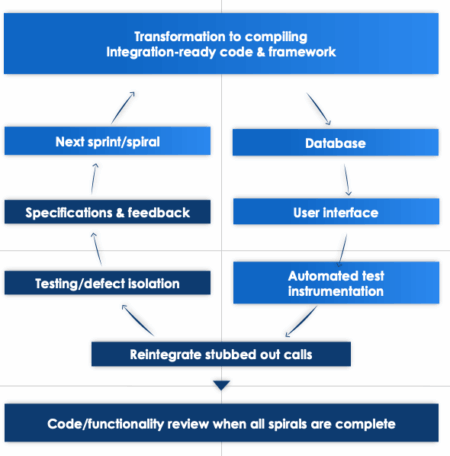
TSRI uses the following methodology to complete this phase:
TSRI ensures that functionally equivalent, modernized code cleanly compiles and links in the new target language with the target-side framework classes and with API implementations that interface with the target-side framework classes.
TSRI uses JANUS Studio® to generate default facade objects or APIs, with classes and methods such as function prototypes similar in form to the legacy application’s original external interfaces, but with modernized application logic. Either TSRI or the client will take on writing replacement API calls at this point.
JANUS Studio® adapts to utilize automation to replace default APIs with native APIs that directly target environment interfaces. Enhancement of deployment architecture typically involves building specialized transformation rule sets to replace the legacy services interfaces with native framework classes in the target environment. TSRI undertakes this effort as an engineering support activity.
TSRI converts the legacy database schema into a relational database structure such as Oracle SQL, Microsoft SQL Server, or an open-source database in a cloud or distributed environment. We also adapt the modernized application code to use the transformed schema. To protect sensitive or classified data, we produce data-loading scripts (ETLs) for the client, or extract, adapt and export legacy metadata and data into the target data, then perform roundtrip validations to prove the equivalence to the original database.
With the proprietary dual Database-Access-Object (DAO) layer, TSRI can target the source/legacy database and the modern database at the same time and allow for a step-wise, go-live, test and integration.
TSRI has the capability to modernize the user interface (UI) to a functionally equivalent look and feel to reduce the need to retrain users and alleviate disruption. We can also modernize to a more modern UI with a RESTful layer and endpoints and, in some cases, systematically improve the workflow for the UI and its users.
One additional option: TSRI can provide a dual-UI layer to keep current users on the same look and feel of the legacy system while allowing new users to onboard to a brand new, more-modern interface.
"*" indicates required fields