Technology & Solution

Technology & Process
Perfected Over 30 Years

Our technology was initially built to serve aerospace, government, and military applications to automatically find and remediate Y2K issues more than two decades ago. The intentional evolution incorporating the advancements earned over a long-standing modernization track record is employed to the benefit of our clients over and over again.

The technology at the core of our solution, called JANUS Studio® AI Platform, is built upon hard work, experience, and ingenuity. We never stop improving. JANUS Studio® is the most advanced framework for automated software assessment and documentation, transformation, and refactoring.

We invite you to share in our vision of creating a world where organizations are not limited by technology. 

Fast-moving train on high-speed rail with light trails at night.

True Semantic Transformation

Our fully automated toolset ingests each software application and truly transforms it into a modern, native, object-oriented target language such as C++, C#, Java, or J2EE, running on Linux, Unix, Windows, and other real-time target architectures.

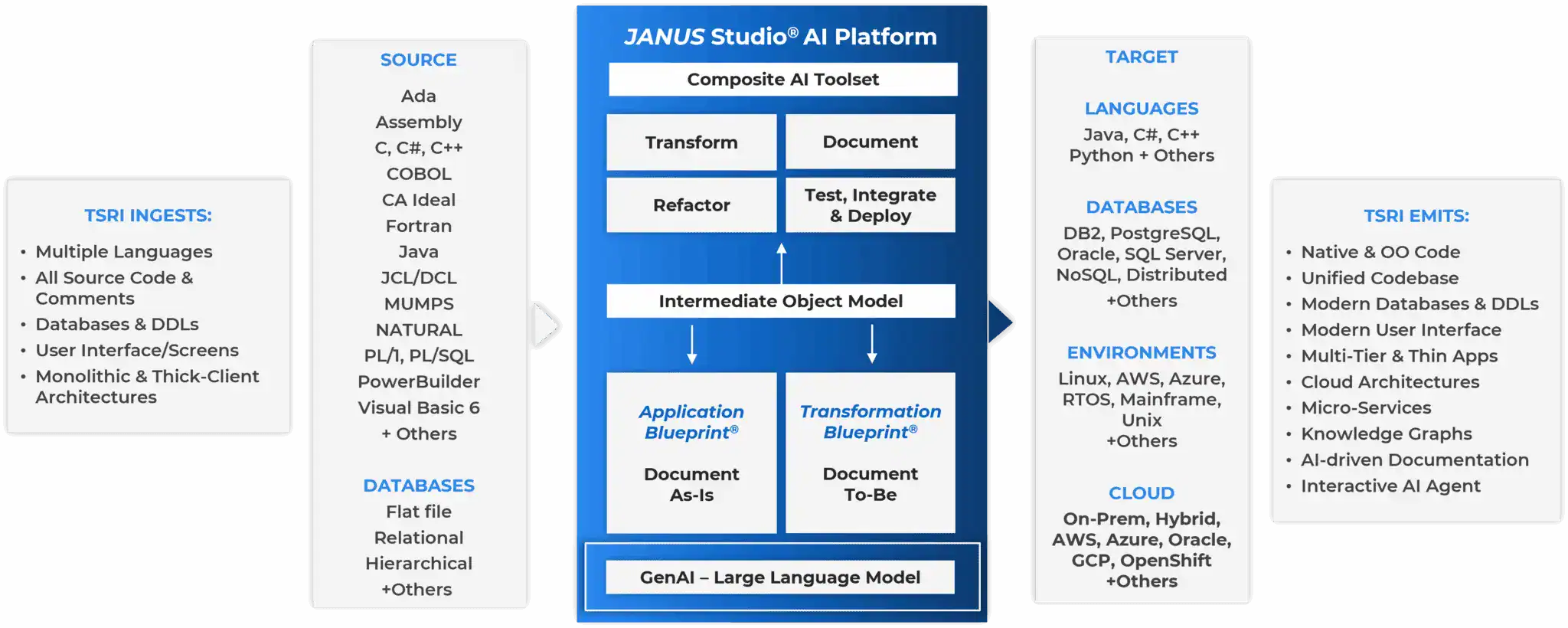
Our Composite AI Approach

The world's first Composite AI-driven automated modernization solution.
TSRI Janus Studio AI Platform for AI model transformation and deployment.
All change is iterative and feedback-driven, accomplished by rules applied to models.

IMPROVED CODE THROUGH REFACTORING

TSRI's fully automated and semi-automated refactoring process reengineers and iterates over the code to improve code structure, quality, security, performance, and maintainability post-transformation based on design patterns, feedback from our partners and customers, and outputs from tools such as SonarQube, VeraCode, PMD/CheckStyle, LDRA, Cast, Fortify, and many more 3rd party tools that can help identify issues but not remediate them automatically. This is where our refactoring shines!

CLEAR UNDERSTANDING & INSIGHTS

Save time and O&M money with TSRI's full UML documentation. We provide comprehensive, on-demand documentation for both the source application and the transformed, modernized application. HTML-based detailed evaluation of the existing system's UML design and architecture provides information that reduces time spent maintaining and developing in legacy, while lending parallel insight and familiarity of the known to better design and improve upon the transformed and modernized output application.

GREATER FLEXIBILITY & MAINTAINABILITY

We transform monolithic applications, their user interfaces and databases into multi-tiered, modular, and cloud-enabled applications into the desired architecture. Our solution features a powerful refactoring capability which helps iterate over code to increase maintainability, quality, and security. The flexible process allows for feedback and changes with each iteration, sprint, and spiral — applied to all code at the same time. The iterative nature of the process allows for a minimal code freeze and minimal business disruption.

TSRI is precise We're here to help you!

35+ Languages... and Growing!

TSRI's language library is continually growing based on customer demand. Our solution not only automatically modernizes the most common languages like COBOL, PL/1, JCL, CA-IDEAL, Assembly, Ada, and Fortran, but dozens more, their databases and user interfaces as well. All use the same proven process and methodology. If you have a combination of languages or one we haven't addressed yet, our solution can handle that, too!

SOURCE LANGUAGES

Ada
Assembly (Vax, HLASM, BAL)
Basic
C, C#, C++
CICS
CMS-2
COBOL
CA-IDEAL

COOLGEN & Other Generators
Dec Basic
EasyTrieve
Fortran
Java

JCL, DCL, Other Control Lang.
Jovial
MagnaX
MUMPS
NATURAL
PL/1
PL/SQL
PowerBuilder
Progress 4GL
RPG
Rust
SQL
VAX Basic (VB)
Visual Basic 6 (VB6)

LEGACY DATABASES

Flat File
Sequential
Hierarchical
Relational
ISAM, VSAM, QSAM
IMS
DB2
Enscribe & Tandem SQL
CA-Datacom
SQL
Sybase
Adabas
+ Other Databases

Stored Procedures
Triggers
Views

LEGACY UI & SCREENS

BMS Maps
MFS Screens
CA-IDEAL Panels
Data Windows
Conversational
Pseudo-Conversational 
CICS
+ Other UI Elements

TARGET LANGUAGES

C
C#
C++
Java
Java J2EE
Java J2SE
Angular
TypeScript
HTML5
EGL
VB.NET
PL/SQL
Python
Rust
+ Other Languages

TARGET DATABASES

Microsoft SQL Server
Oracle SQL Server
PostgreSQL
MariaDB
MongoDB
NoSQL
Aurora
Distributed Databases
+ Other Databases

TARGET PLATFORMS & ARCHITECTURES

Multi-Tier Architectures

Thin-Client Architectures
DAO layer
UI/Presentation layer
Application layer

Modern Frameworks
Bootstrap
SpringBoot
.NET & .NET Core

HTML5 &CSS
AngularJS
ReactJS
Google Guice & Closure

Web-Enablement
Cloud-Enablement

Fully Automated Introduction of:
RESTful interfaces
Micro-Services
Cloud Architectures (AWS, Azure, BlueMix, OpenStack, Google Cloud Platform, Cloud Foundry)

Languages listed above in bold include our limited Transformation Warranty,
where TSRI warrants the code to be free of any transformation-related errors or defects.

That is how accurate our modernization solution is.

The TSRI
Difference

0x%

LEVEL OF AUTOMATION. THE LEADER.

0+

INPUT & OUTPUT LANGUAGES

0+

SUCCESSFUL MAJOR PROJECTS

0+

CLIENTS & PARTNERS

0B+

LINES OF CODE MODERNIZED

Automated application transformation of any practical combination of languages
Award-winning, architecture-driven, model-based, rule-driven application transformation
Fully automated modernization of mission-critical information systems
AI-Based software modeling, assessment, transformation, and refactoring
Trusted provider for commercial, government, and military migrations

Frequently Asked Questions

There is no manual intervention required to transform code via our JANUS Studio® toolset; it is really 99.9X% automated. Even the little bit of a percent we hand patch we can roll into our automation for the next project.

This high degree of automation is due to our modeling process. As the first step during our modernization, TSRI needs to create a full and complete model of the application. This is where all the work that TSRI does, for example refactoring and redesigning, happens.

TSRI’s approach has a 100% success rate over all 130+ major modernization projects we have undertaken, all of which are reference-able projects. This is not magic, but the result of a fully-automated code documentation and transformation process as well as a disciplined and free pre-project assessment phase during which TSRI will identify any potential risks to the project.

The JANUS Studio® transformation provides code that is accurate and uniform, eliminating the risk of technical failure. TSRI reduces financial risk by operating on a Firm Fixed Price (FFP) basis for initial tasking and Firm Fixed Rate (FFR) for testing and implementation support. While manual and semi-automated transformations rely on coordination of many—often hundreds—of developers, TSRI’s automated processes typically require only a handful of project management engineers, typically fewer than 10 people, avoiding the risk of key personnel departures. Finally, because a code freeze of only a couple days to a week is required, maintenance and updating can continue on the application all through the assessment and development process, eliminating the risk, business disruption, and project failure associated with long code freeze periods.

TSRI is able to achieve a 100% level of code automation in our artificial intelligence-based transformation engine called JANUS Studio®.

Our tool transforms 1 million lines of legacy code into modern code, in about 30 minutes. This is not magic, but the result of using a 100% automated, iterative code conversion process that has been developed over 2 decades, and hundreds of millions of lines of code. Test-ready code will be produced through this iterative process, which will then need to be tested, integrated, and fielded.

Yes, definitely. If you can provide TSRI with a portion or all of your source code (under NDA if neccessary), we can generate a first-cut Transformation Blueprint® of your source code, which will be available to you as a free preview.

This allows you to review your source code and the transformed code, side-by-side. The Blueprint also shows other artifacts, such as structure of the code with Structure Charts, Control Flow Graphs, Data Flow Diagrams, State Machine Models, McKabes' Complexity Index, Similar Code and much more.

This is also where we identify all the gaps that we may have found in your code base and need to adapt to.

Although we have experience transforming code in a variety of industries, whether it's government, defense, financial, insurance, entertainment, logistics, or commercial, our toolset is truly industry neutral. The specific functionality of the application, as well as its external interfaces, databases, user interfaces, and other factors do not affect our ability to transform the application to a functional equivalent in a new language and architecture. TSRI has modernized everything from submarine weapons and satellite code to billing applications for major telecommunications companies. Our language and approach will be applicable to your source application.

There are a few main reasons why legacy code modernizations fail.

First, manual rewrites can take a great deal of time, particularly for large applications. During this time, changes to the project goals may cause further delays or even cause the project to restart from the beginning. The cost for manual rewriting of code is already very high, and so starting over becomes particularly costly.

Also, long code freezes of months and years are common with manual or semi-automated conversions, which result in major issues for your user base, and eventually project failures.

Transliterative tools that focus on line-by-line translations of the source code into the modern code are also widely used. Just as using a dictionary to translate from another language to English one word or sentence at a time would result in many areas of confusion, so these tools produce results that don’t accurately reproduce the functionality of the original application. Even when completed, this results in complicated and unmaintainable applications.

Finally, the costs associated with large numbers of people on partially automated and manual modernization projects can be very high. These costs grow as features are added or changed several months or years into the project, until millions and often hundreds of millions have been invested.

The fully 100% automated functionality of TSRI’s JANUS Studio® solves all of these problems, and it's the reason all of our past projects were successfully completed, and all of our past projects are referenceable. This perfect track record of success has been honored with recognition ranging from the Stevens Award for our founder Philip Newcomb, as well as the Top 20 Most Promising Defense Technology award from CIO Review

Since the late 1980s, we have seen many solutions hit the market. Below is an overview all the options we typically see. Generally, there are 5 Modernization/Migration Options:

  1. Fully Automated Modernization
    • This option fits well for large, single or multi-language applications that are actively maintained, valueable and irreplacable. TSRI's solution uses model-driven, AI-based, fully automated methods to achieve 100% automation in the modernization of a source application to a target language and architecture of your choice.  Learn more about the advantages of the fully automated approach here.
  2. Semi-Automated Modernization
    • Semi-Automated Modernization technologies can work if the source application is small or very small and you have a specific reason to choose a less automated method. However, because of the manual input required to fill gaps in the transformation, the transformation risk with semi-automated modernization increases corresponding to the size of the application, because humans are in the loop touching the code and introducing errors. For example, transliterators (which translate code "line by line") produce legacy-like target code that must be manually edited. Other semi-automated model-driven approaches require additional manual rewriting, often for large amounts of code at large expense and risk. This increases the chances of schedule overrun and increasing costs, and does not allow for automated refactoring, or flexible approaches that allow for mid-project changes.
    • As a result, semi-automated solutions that can handle one or two languages are typically not good solutions for larger projects. Even an automation level of 95% on a 1 million line application means 50,000 lines of code or more must be manually written at dramatic expense.  
  3. Application Rehosting and Replatforming
    • Rehosting is a good solution if the application is not actively maintained and only needs to move from its current hardware/platform. This solution retains the legacy language, and so development/maintenance continues to be difficult and costly, and exposes the customer to increased technical debt as fewer and fewer resources are available. Also, the significant license costs associated with rehosting can be unattractive for customers.  In fact, the effort to undertake a TSRI modernization is often equal or lower than 1-2 years worth of licensing cost.
  4. Custom Off-the-Shelf (COTS) Solutions
    • COTS replacements are very common for replacing general applications that do not have many custom features. Usually the COTS applications look completely different, have different functionality and have license costs associated with them. This requires costly and lengthy retraining of the current users who are not familiar with the new system and rely on the vendor to "make them work" for the business scenarios. Again, license costs and vendorlock are other disadvantages, as is the ability to maintain and modify the application moving forward.
  5. Manually Rewriting Applications
    • Definately the most costly, highest risk and longest approach is rewriting the code manually. This is an approach often used on applications that need massive forward development and required major changes in functionality. The Standish Group, an independent research firm, clearly shows that the high liklihood of "challenged" or "failed" projects, based on hundreds of modernizations/migrations/replacements, should be a major consideration for any manual redevelopment effort. Most of TSRI's successful large modernizations follow a failed manual effort that expended millions or tens of millions of dollars before being scrapped. Request a copy of the Standish Group report here.

TSRI’s JANUS Studio® generates richly indexed and hyper-linked system-level design documentation of the entire legacy system. This is called “As-Is” documentation of the source system, also called Application Blueprint®. Once the system is in its modernized state, the target code is also documented. This is called “To-Be” documentation, also called a Transformation Blueprint® . The “As-Is” and “To-Be” documentations can be combined to allow a side-by-side view of both systems. Customers may receive a free Transformation Blueprint ® using a sample of their own code and choice of target language.

Because our toolset is tuned to the source code to perform near-100% automated code transformations very rapidly, we can make changes to the transformation specifications and then re-transform the entire application after that change is made. While bringing a great deal of flexibility to the project, this allows also us to perform refactorings like eliminating dead and redundant code, code consolidation, architectural level refactorings, or simply make changes to improve maintainability and readability,  then re-transform the code very quickly.

TSRI’s JANUS Studio® is a suite of integrated tools from which TSRI provides fully automated modernization processes. Specifically JANUS Studio® will:
1. Perform detailed analyses of legacy source code.
2. Transform legacy source code into modern target languages.
3. Perform initial detailed analysis of target code (to support testing).
4. Apply fully automated refactoring operations.
5. Iteratively apply semi-automated refactoring operations.
6. Perform final detailed analysis of target code (to support testing and future system maintenance)

Yes, TSRI can modernize the GUI and database. We have modernized many different databases such as flat-file, hierarchical, and relational databases. Most of our target databases are relational, such as Microsoft SQL Server, Oracle SQL Server, but we also modernize non-SQL databases and open-source databases.

In regards to online and batch, we do modernize batch and online code. Almost all of the modernization projects included a GUI, online, database, and batch code.

Typically the client or system integrator will be responsible for the following tasks:

  • Customer identification and relations
  • Executive program management
  • Joint proposal preparation
  • Requirements definition
  • Providing input on generated code for refactoring
  • System testing and implementation
  • Stub implementation for external interfaces
  • Future system enhancements and forward development
  • System lifecycle support
  • Training of end users

TSRI works in support of the client and system integrator for the entire project.

Start Your Modernization
Journey Today!

Message us today to learn more about our code modernization process, transformation approach, migration methodology, and whether our modernization solution is a great fit for your modernization scenario.

Our transparent and flexible approach will help modernize your legacy software application with the least amount of risk and the shortest schedule. From Mainframe, Mid-Range, On-Prem, to even Embedded Systems or modern applications - TSRI can model and modernize + refactor such applications to a new target!

We are excited to talk to you and explore how we can best help modernize your applications!

Contact Form

"*" indicates required fields

Name*
TSRI research laboratory with scientific equipment and researchers.
The Software Revolution, Inc. (TSRI)
11332 NE 122nd Way, Suite 300
Kirkland, WA 98034-6949
USA
SOCIAL MEDIA
Copyright © 2026 TSRI